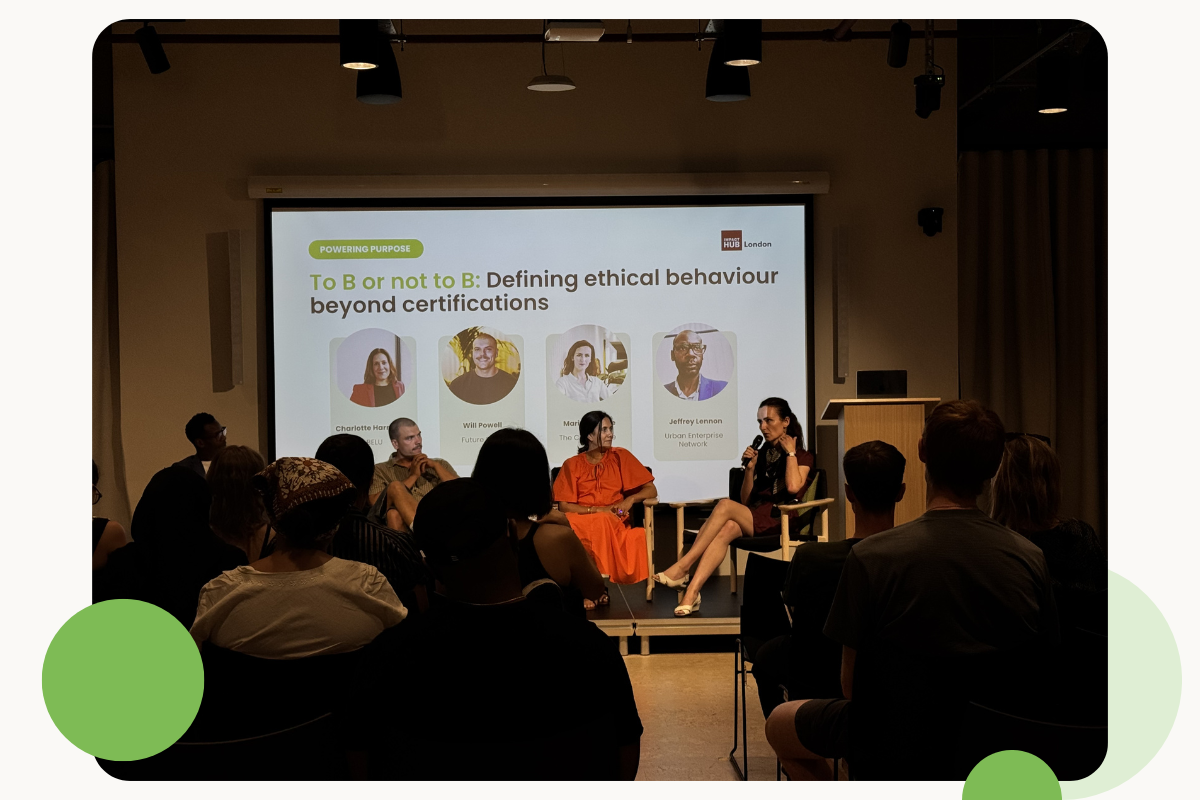
On a warm – and we mean warm, it was 36 degrees – June evening at Impact Hub London, we welcomed a room of founders, sustainability leads and curious business owners to wrestle with a deceptively simple question: what actually makes a business ethical, once you strip away the badges and certifications?
The panel – Charlotte Harrington, CEO of Belu Water, Marie Geneste, Founder of The C Collective, and Will Powell, Co-founder of Future Shift – didn’t offer a tidy and simple answer because as we discovered, it isn’t that straight forward. Instead, the conversation kept circling back to the same idea: certification is a starting point, not a finish line, with facilitator Jeffrey Lennon, Founder of Urban Enterprise Network steering the panel to delve into what that means. We want to share some of the themes that stood out.
1. “Ethical” isn’t a fixed state – it’s a direction of travel
Will opened with a line that set the tone for the whole evening: you can’t be an ethical business, but you can be a better one. Charlotte picked up the thread, arguing that business can be a genuine force for good – not by claiming perfection, but by giving people the tools and permission to make better decisions in small, consistent moves.
“Business can be a force for good, there are different ways of going about business. You give people the tools and they can make better decisions and small moves to be better.” – Charlotte Harrington
Marie went further, naming the real obstacle: the bar is simply too low, because most organisations are still built to prioritise profit above everything else. She used the doughnut economics framework to share how to consider reframing the goal – not maximising growth, but pulling activity back toward the centre of the doughnut, where human needs are met without overshooting planetary limits. For Marie, this isn’t just good practice; it’s a moral imperative and, increasingly, a matter of survival.
“The problem we have is that most people prioritise profit but as an organisation, it is about trying to contribute to humanity too.” – Marie Geneste
2. Structure your business for impact, not just intent
Perhaps one of the best ways to see what a purpose-led business looks like is through hearing Charlotte’s experience at Belu.
Belu Water is an award winning social enterprise that invests 100% of their profit in pursuit of their purpose. The business gives away 100% of its profits (well beyond the 50% threshold typically required of social enterprises), is wholly owned by the Belu Foundation, and has written sustainability commitments directly into its governing articles. It trades as a normal commercial limited company – profit-generating, just structured differently from the outset.
Will rightly drew a direct comparison to the very famous and popular brand, Patagonia: highlighting how the way a business is founded and owned shapes everything downstream.
The encouraging message for smaller businesses in the room: you don’t need Belu’s ownership structure to apply the same logic. Intent can be replicated at any size – through who sits on your board, who advises you and as Charlotte pointed out, a willingness to ask, “just because it’s always been done this way, what if we did it differently?”
3. Values only count when they’re tested
Internally, Charlotte described Belu’s operating model as four Ps – purpose, people, product and then profit. Whilst they operate as a small team, they deliberately paired with partners who understand and respect the values they live by. One point Charlotte raised was about authenticity under pressure: on a good day, everyone lives by their values – the real test is whether they hold when times get tough. Values that only exist on a poster aren’t values; they’re something you actively use to govern decisions.
On building internal buy-in, her advice was about consistency: repeat the same message often enough that it compounds, and actually listen to what comes back. Staff don’t need to understand the P&L – they need to understand their own role in living the values. Get that right, and your team becomes your best external ambassadors to communicate the purpose of the organisation.
4. Clarity beats jargon – every time
Will offered one of the best ways to visualise how messaging can become muddles:
“If I asked you what a pencil looks like, you would know. But if I ask you what sustainability looks like, the message is more confusing.”
That vagueness is exactly what makes greenwashing possible and what erodes trust once businesses over-claim.
“When businesses start labelling themselves as sustainable, it can lack credibility as there is a lack of transparency.” added Will.
Will shared some further advice on how to approach and communicate your impact; don’t try to solve everything at once (net zero and everything else, all in year one), pick a few genuine changes, be transparent about where you are, and don’t make audacious claims you can’t back up – audiences lose faith fast when the gap between promise and reality shows.
VIVO Barefoot’s approach to radical transparency was held up as a good model: be open, be honest, be transparent.
5. Certifications are useful — but only as a means, not an end
BCorp came up repeatedly as the certification with the most recognisable weight, particularly for B2C businesses, and a credible entry point to show your impact and sustainability credentials.
But the panel was clear-eyed about its limits: it isn’t everything, and for some businesses – particularly those working B2B or as contractors – the right certification may be a different one entirely.
They also discussed a practical, competitive edge to being BCorp certified: without some form of credential, businesses risk losing out on investment, talent and client contracts, as well as more people starting to make values-aligned decisions about who they work with and buy from.
Marie’s framing was the one worth remembering: pursue certification only if it actually drives change. The real value isn’t the badge – it’s that pursuing it forces you to start measuring impact and start the process of genuine change.
6. Ambition needs accountability
The closing discussion turned to target-setting, with Jeffrey asking whether businesses should be overly ambitious when setting targets. The panel agreed that ambition is right in principle – everyone should be stretching themselves – but Will pointed out that “Fundamentally yes, everyone should be trying to stretch themselves, but targets without the accountability are just numbers on a board.”
He also named the tension many businesses are navigating right now: competing crises (cost of living, war, economic pressure) can push climate action down the priority list, treated as a problem for “50 years from now” rather than today. And if the heatwave we were in the middle of was anything to go by, we know it certainly isn’t something that should be pushed down the line.
The way through, in Will’s view, is dropping the jargon and avoiding all-or-nothing framing. Telling people they simply can’t eat meat, or must abandon familiar habits overnight, shuts down engagement rather than building it – and that disengagement ultimately shows up in policy and politics too.
Marie closed with a note of optimism: cities – referencing Copenhagen and Amsterdam – are already showing what’s possible, often moving faster and more practically than national policy. It offers insight into how these values and ethics can be embedded at a wider scale.
The main takeaway
The evening’s message was strikingly simple: start somewhere, be honest about where you are, structure your business so your values are embedded rather than decorative, and treat certification as a tool for real change rather than a marketing asset.
Thank you to our brilliant panelists, our facilitator Jeffrey Lennon, and everyone who joined us in person.