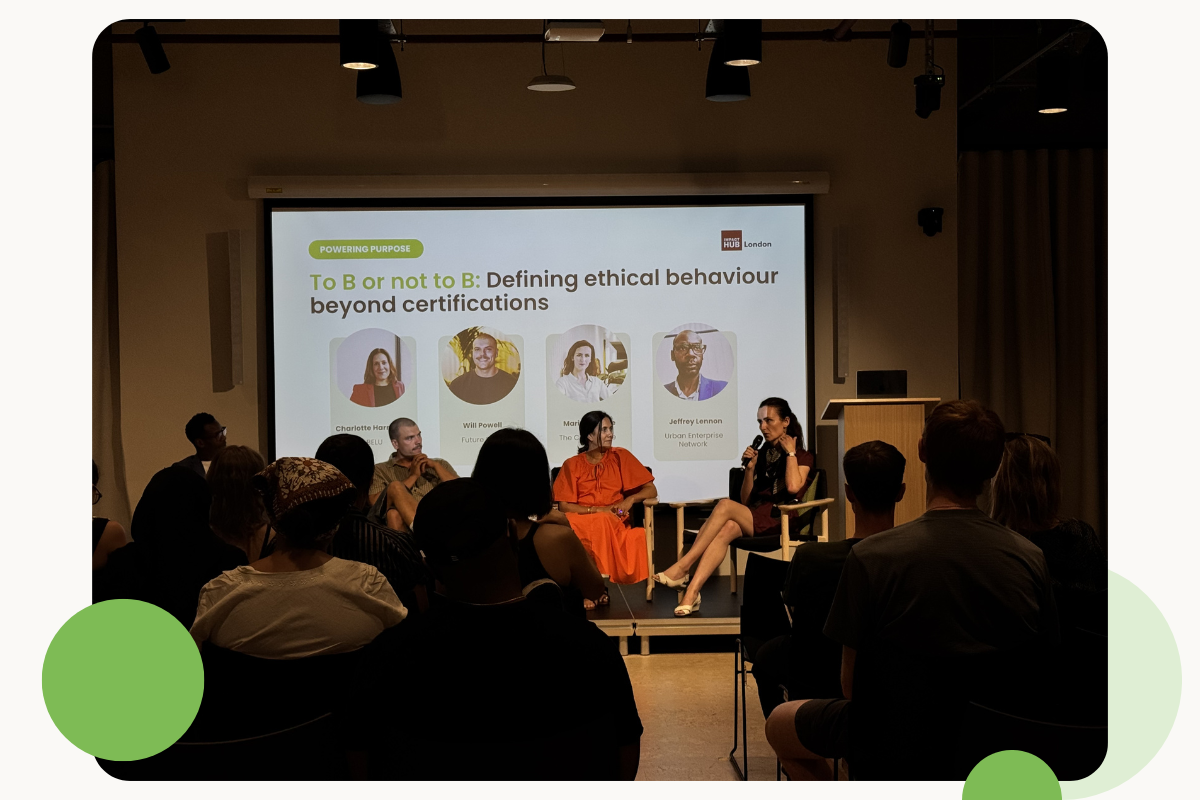
The new B Corp standards are designed to drive deeper accountability amid greenwashing becoming more prevalent and concerns around saturation – but are they accessible to all businesses?
For many businesses, becoming a B Corp has long represented a clear signal of intent: a public commitment to doing things in their business better. It has been a framework, a badge, and for some, a competitive advantage.
But now we are looking at significantly more rigorous standards beginning to roll out, the conversation around B Corp certification is shifting. The question is no longer just “How do we become a B Corp?” – it’s “Can we realistically stay one?”
What’s changing and why is it happening now?
The new B Corp standards are there to raise the bar, in the words of B Lab;
“As the climate crisis intensifies and societal inequality grows, the need to bring about systemic change is clear. That’s why B Lab has strengthened its standards for business impact, equipping companies to drive meaningful, sustainable change.”
The new B Corp standards are designed to raise accountability across five key areas: governance, workers, community, environment, and customers. In principle, this evolution makes sense. As the movement grows, so too does the risk of dilution – there has been plenty of talk of greenwashing and issues with companies qualifying yet having damaging practices.
The introduced higher standards aim to ensure that certification continues to mean something – not just symbolically, but that the companies that are certified are showing operationally too.
In many ways, this is a natural moment of maturity for the movement. With thousands of certified businesses globally and rapid growth in the UK, B Corp can no longer afford to be seen as aspirational alone. As it evolves, and as it becomes more scrutinised, it must be measurable, comparable and robust.
Yet raising the bar also raises an important question: will there still be people able to clear it?
When higher standards meet limited capacity
Naturally, with new standards comes the additional paperwork.
For large organisations with dedicated ESG teams, legal support and compliance, increased rigour may be challenging but manageable. It is something that the teams likely expect, able to make the resources available easily to get it done.
However, for SMEs, social enterprises, and growing businesses, the picture can look very different.
The reality for many organisations is that the biggest barrier isn’t values – it’s capacity. These companies already face increasing demands as the economic landscape puts pressure on their plans and goals, and adding in the additional rigour of a recognised certification is something they may find tough.
There is the time-intensive data collection, complex reporting requirements, internal policy formalisation and the cost of external support can quickly turn certification from a values-aligned goal into a resource-heavy undertaking. In some cases, businesses are forced to ask whether the time spent proving impact outweighs the time spent creating it.
This doesn’t mean the standards are wrong – but it does raise an uncomfortable tension at the heart of the movement.
Is B Corp becoming a gold standard – or an exclusive one?
There is a strong argument that B Corp standards should be difficult. After all, if they represent best practice, they should push businesses beyond incremental change. It has to be said that to make the changes needed in the world, big and drastic measures are needed.
But there is also a risk that increasing complexity creates a two-tier system:
- those with the resources to certify and recertify – who may not necessarily be doing the good the certification could imply but have the budgets to facilitate
- and those doing meaningful work without the capacity to formalise it through certification
If certification becomes inaccessible to the very organisations driving grassroots innovation and social impact, the movement risks narrowing rather than expanding its influence.
This is where the debate becomes less about compliance and more about purpose.
What is the role of B Corp in the next phase of better business?
Perhaps the most important question isn’t whether the new standards are “too high” but whether certification is being positioned as the only credible marker of ethical business.
If B Corp is the pinnacle, what sits beneath it? And how do we ensure businesses that choose not to certify – or not to recertify – are still supported, visible and held to meaningful standards?
It’s important to ensure that these businesses are still seen to be doing the good that they are, whether they have the certification or not.
There is an opportunity here to reframe B Corp not as the definition of responsible business, but as one powerful tool within a broader ecosystem – one that includes community accountability, transparent reporting, living wage commitments, environmental targets and values-led governance.
We need to build inclusive pathways as well as building higher standards
As businesses across the UK weigh up what recertification means for them, this moment calls for honesty rather than defensiveness. The future of better business depends not just on higher standards, but on inclusive pathways to impact.
Raising the bar is important. But so is asking who we expect to clear it, at what cost and whether that cost is viable for the organisations out there?
About Impact Hub London:
Impact Hub London is where purpose-led change-makers, entrepreneurs and organisations come together to build solutions for a fairer, more sustainable future. We enable and connect entrepreneurs with this mission with a wider ecosystem that helps to support them on this journey.
What we do: We offer affordable workspace solutions (coworking memberships, fixed desk, private offices), sustainable spaces for meetings and events, and impactful programmes within the social and environmental space. You can learn more about what we do by clicking here.